What Is DND
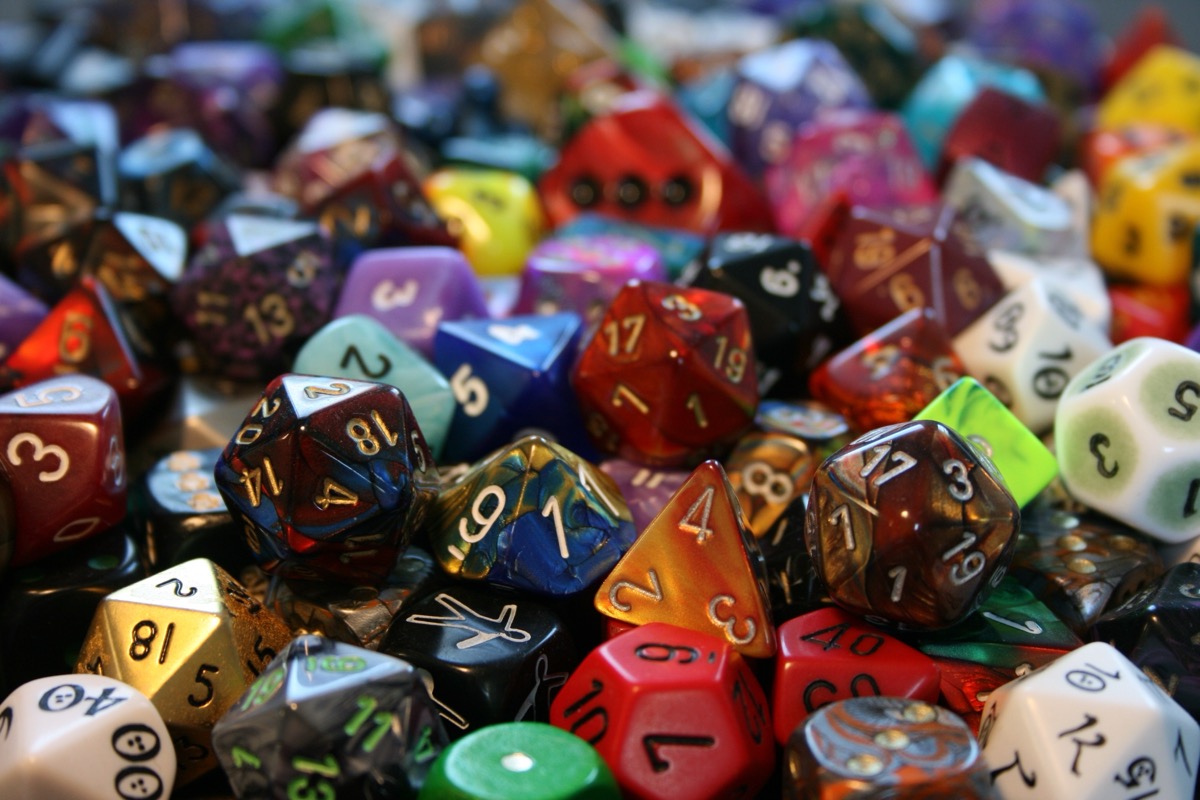
Dungeons and Dragons (D&D) is something that I will be writing a few posts about. This first one will be about the game itself, what it is and why I like it. The subsequent posts on playing the game and running the game will be using D&D as the basis, with maybe a brief mention of Exalted or other systems but will generally apply to all tabletop role playing games (TTRPGs).
What is a TTRPG
A tabletop role playing game is a social game where a group of players and a storyteller work collaboratively to tell a story of the adventures of player-generated characters. There is usually some way to decide the outcome of scenarios, usually dice, but some use cards, spinners, or some other form of semi-random / random resolution.
Most TTRPGs will be somewhere on the scale of combat simulation to life simulator. The combat simulation TTRPGs tend to focus less on the narrative and more on combat scenarios, whereas the life simulators tend to be more about politics or social encounters.
Role-playing is an important aspect of TTRPGs, and again this will vary depending on the system and the group. Some systems lean heavily towards role-playing and others it is considered very much optional. No matter the system some groups will have heavy, middling, or no role playing. Some people will go as far as dressing up as their character and put on a voice, others will just be ‘in character’ and put on a voice and attitude, some will try to act in character but not do a voice, and others ignore it completely. It is an important point that you find or run a game that you feel comfortable in, and you should never feel pressured to act in a way you don’t enjoy.
Setting
D&D is a high fantasy setting (other than Spelljammer) heavily influenced by things like Lord of the Rings, which includes many of the standard races like elves, dwarves, orcs, etc…. It has many of the standard tropes when it comes to classes for your character, like fighter, wizard, cleric, ranger, and many more. One of the wonderful things about D&D is that it is very easy to make your own settings. Personally I like to make up my own nations and lore when I run a game, although I am currently using the Critical Role adventure setting.
D&D includes a great and detailed lore (which is optional), and there are many books set in the setting including the Drizz’t series and some films. Wizards of the Coast also has many pre-built adventures set in many parts of the D&D world. The world is made up of planes, which helps with home-brew settings, but generally include things like elemental planes, sub-planes for pre-built adventures, named planes like the Fae Wild and many more. This is also where Spelljammer comes in, as it’s a setting that includes ships that travel the astral sea between the planes and is a science-fantasy theme.
Hobby
One of the things that is great about D&D as a hobby is that it is a group activity that encourages people to work together to progress a largely unknown story. It encourages problem-solving and thinking outside the box to solve puzzles, bypass encounters and even win combat scenarios. The rules as written are quite comprehensive, but many Dungeon Masters (DMs) will allow things that the rules don’t specify if it will be epic, interesting, or funny. For example, if there is a group of enemies that you need to get past for whatever reason you could:
- fight them
- create a distraction to draw them away
- sneak past them using stealth
- bribe them
- persuade them you should be there
- intimidate them
- use some arcane shenanigans to get past them
It is a great way to meet other nerdy people from a wide and diverse set of backgrounds, and I have met some of my best friends through the game. The hobby was almost exclusively an in-person hobby until COVID, and now most of the people I know who play are still playing games remotely. This boom of remote playing has introduced many great tools like virtual table tops (for running combat and maps), for example: Alchemy and Foundry VTT, tools for managing characters like those provided by D&D Beyond, bots for chat systems like Discord for rolling dice and many others. While many of us enjoy remote play and love these new tools, many people still prefer in-person games, and there are quite a few debates on the subject across many forums.
Roles
There are two real roles in D&D (and most TTRPGS), that of the storyteller (Dungeon Master in D&D) and player. There will be two follow-up articles on the roles in depth coming soon.
The DM is the person who creates the encounters and provides the plot hooks for the adventurers to follow. It is often said that the DM is the one who tells the story that the players act out, but this is not really correct as I have found in the best games the players tell the story in the world that the DM provides, and I have a lot of fun when the players ignore the plot hooks I provide and I’m left improvising a new one.
The player’s role is to tell the story of their character. Depending on the level of role playing involved, this can vary as described above.
note: The players and the DM are not trying to defeat each other, this is a common misconception a lot of new player make when first starting out.
Getting into the hobby
The easiest way to get into the hobby is to find a group near you (with a lot of googling) that allows new players. Many board game shops that sell the books will also have evening sessions and provide tables, so they are a good place to look. If there is a group of you, then you can buy one of the starter boxes. These include a basic adventure, map, pre-made characters, and a basic rule set. This is how I got into the game, I found a group from my local board game shop (Black Lion Games in Edinburgh) who met in a local pub and bought a starter set and turned up, unfortunately there were a no spaces in any of the games but there were a few other people who wanted to play so I ran the adventure and had a few experienced players and DMs to help with rules questions.
Other Media
With the massive surge in popularity of D&D, there are many new shows in the media. Shows like Critical Role and Dimension 20 are two of the more famous; all of the players and the DM of Critical Role are professional voice actors, and Mat Mercer is an amazing DM. The shows include a lot of sponsorship, which gives them access to a lot of advantages that many DMs do not have, like fancy set pieces for maps and fancy tables that most DMs wouldn’t be able to afford. This has actually caused issues in the hobby as many new players who have seen the shows expect all games to be like that. I personally am a fan of drawing maps on a roll-up dry-erase sheet, which is far more low-tech and not as fancy as the ones people see on the shows. I am also not a professional voice actor and can’t do voices so I don’t. I have never had a complaint on this but many other DMs I have spoken to have had this problem with new players.
D&D has also been the basis for and inspiration for many games and was the backing system for The Knights of the Old Republic games and many like it. Set in the D&D universe, there is:
- Baldur’s Gate 1, 2, & 3
- Icewind Dale
- Neverwinter Nights 1 & 2
- Neverwinter MMO
- and many more
In a similar manner to the streamed games like Critical Role these games have introduced their own issues to the hobby. Some people, especially recently with the release of Baldur’s Gate 3, expect things that are introduced into the game to translate the hobby into that format to be the same when playing the TTRPG. This is not always the case and can cause rule confusion during gameplay.